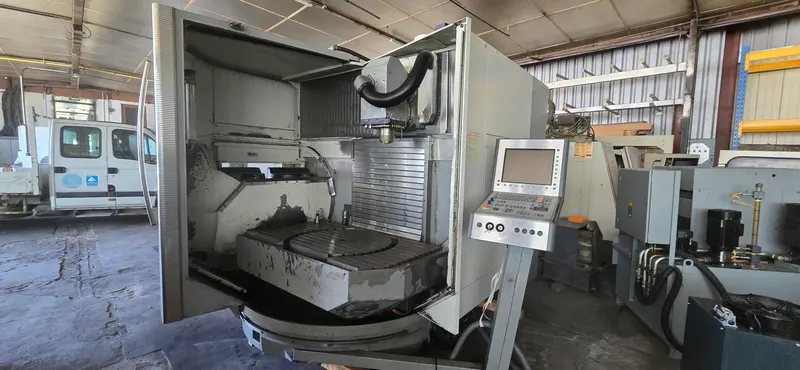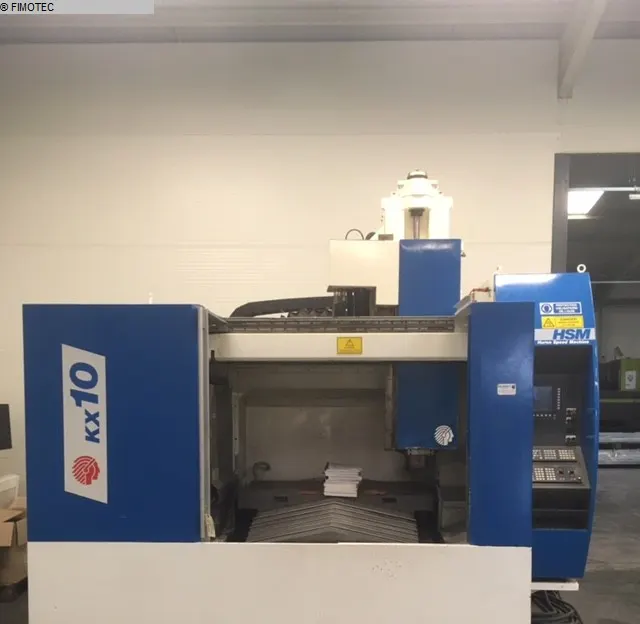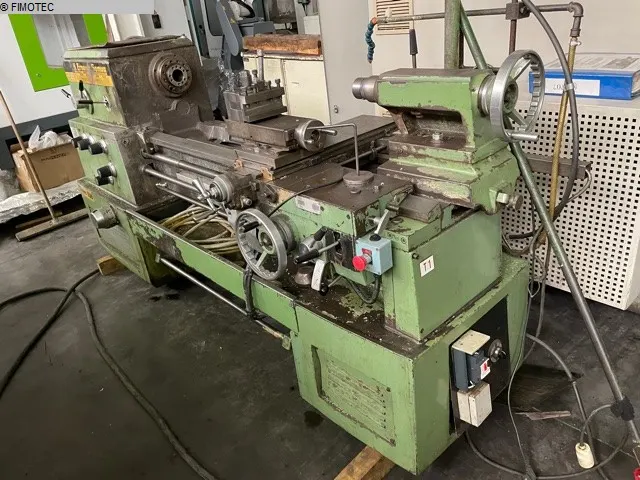
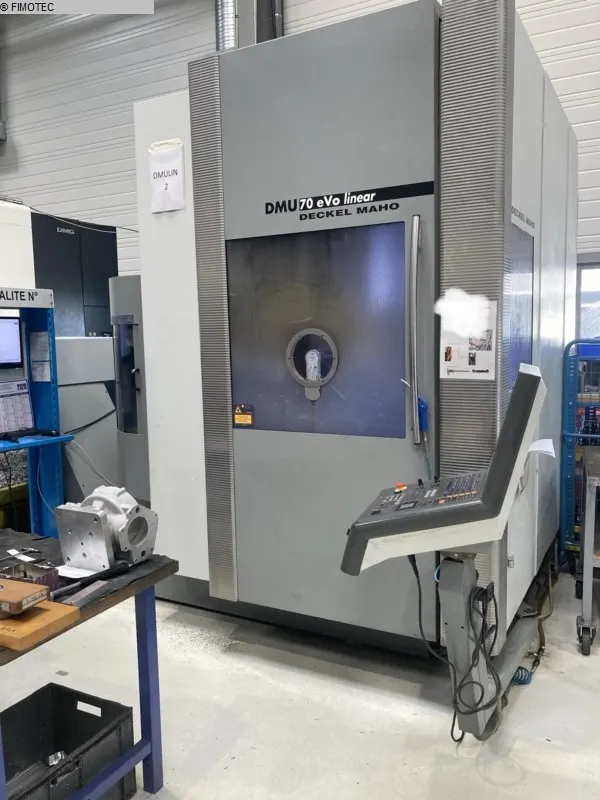
A used machine tool can meet a production need quickly, provided you know exactly what you are buying. Before committing, it pays to review the mechanics, the CNC control, the peripherals, the documentation and the regulatory framework, and to plan transport and installation ahead. Here are the points to check, one assembly at a time.
The spindle
The spindle drives the tool on a milling machine or machining center, and the workpiece on a lathe. On CNC milling machines and machining centers it usually comes with a hydraulic tool clamping system and a taper that allows automatic tool changes.
- Listen to the spindle across its whole speed range: bearing noise, whistling or vibration are signals worth investigating.
- Watch how much it heats up after running for a while.
- Measure runout with a dial indicator, on a test arbor or a mounted tool.
- Check tool clamping and unclamping and the condition of the taper: impact marks, rust, signs of seizure.
The axes: backlash and geometry
Backlash is the distance a part can move in one direction without moving the next part in the drive train. Wear is one of its main causes. Preloaded ball screws keep backlash low, but a CNC control can also be set to compensate for the backlash on each axis: a large compensation value in the parameters can therefore hide mechanical wear.
- Check the backlash of each axis with a dial indicator, reversing the direction of travel.
- Note the compensation values stored in the control.
- Check squareness and straightness of travel.
A ballbar test, which measures variations in radius while the machine follows a programmed circular path, reveals geometric, dynamic and play-related errors without having to machine and inspect test parts.
Slideways and guideways
Guideways carry the slides and determine the accuracy of the machine. Depending on the model, they are plain slideways or rolling-element guides.
- Look for scoring, seizure marks and unusually polished areas.
- Check the wipers and telescopic covers, which keep chips and coolant away from the guideways.
- Run each axis over its full travel to detect a tight spot or an unusual noise.
The CNC control
Identify the make, model and version of the control (Fanuc, Siemens, Heidenhain, Num…), then check:
- that it starts without persistent alarms, and the alarm history;
- that a backup of the machine parameters and programs exists;
- the condition of the screen, keyboard and program transfer options;
- compatibility with the way you program: CAM, shop-floor programming or ISO code.
The tool changer
- Index the magazine through all its pockets.
- Run several tool changes in a row and watch for jerks or hesitation.
- Check the grippers and the tool holders supplied with the machine.
Hydraulics, lubrication and coolant
- Look for leaks around the hydraulic unit, cylinders and fittings.
- Compare the displayed pressures with the values marked on the machine.
- Make sure the central lubrication works and that lubricant actually reaches the lubrication points.
- Inspect the coolant tank, the pumps and the chip conveyor.
The electrical cabinet
- Cleanliness: no metal dust or oil inside the cabinet.
- No signs of overheating, and no cables added or modified without labels.
- Working cabinet ventilation or air conditioning.
- Wiring that matches the electrical diagrams.
Documentation
Ask for as many documents as possible: instruction manual, electrical diagrams, control manuals, parameter list, maintenance history. They make recommissioning, troubleshooting and operator training easier.
Safety and compliance in France
The French Labour Code (Code du travail) governs the transfer of used machinery. A machine is considered used when it has already been used in a Member State of the European Union. A used machine imported from outside the European Economic Area is considered new: it must follow the procedures that apply to new machinery, including CE marking.
- When a used machine is sold, rented or transferred, the person responsible hands the recipient a certificate of conformity stating that the machine complies with the technical rules that apply to it (article R. 4313-14 of the Code du travail). These are the rules that applied when it was first placed on the market.
- For a CE-marked machine, the original declaration of conformity and the instruction manual must accompany the machine.
- According to INRS, the French occupational safety institute, this certificate is only a presumption of conformity. The buyer must check, with the help of a competent third party if needed, that guards and stopping devices are present and work properly. CE marking alone does not establish that a used machine complies.
- A non-compliant machine may not be put into service. Article L. 4311-5 allows the buyer to ask for the sale to be cancelled within one year of delivery when the equipment was delivered in breach of the applicable rules.
The power-on test
Nothing replaces a demonstration of the machine under power. Plan for:
- a warm-up, then moving every axis at different speeds;
- running the spindle up to speed;
- several tool changes;
- testing the emergency stops, doors and guards;
- if possible, machining a part representative of your production, then measuring it.
Transport and installation
A machine tool is rarely moved without preparation. Depending on its weight, it must be set on a suitable foundation and then adjusted.
- Note the weight, the dimensions and the lifting points.
- Plan any dismantling of sub-assemblies and the protection of sensitive parts.
- Check access to the building: door width and height, floor strength.
- Plan the power supply, compressed air and room for the chip conveyor.
- Allow for shimming and leveling on arrival.
At Fimotec
Fimotec offers used machine tools in stock in Haguenau, France. Each machine page lists the specifications recorded on the machine and, when available, the manufacturer's data, together with a tier: "Entry-level", "Production machine" or "High performance". The price is given on request, transport and installation can be arranged on request, and every request gets an answer within 48 working hours. To ask about a machine, contact Fimotec.