Conventional lathe or CNC lathe? Both machines rotate the workpiece to machine it with a tool, but they do not meet the same needs. One leaves control to the turner, the other runs a program. The right choice depends on the parts to be made, the quantities, the skills available in the shop and the time that can be spent on preparation. Here are the criteria that matter, and where turning centers and sliding-head lathes fit in.
The conventional lathe: in the turner's hands
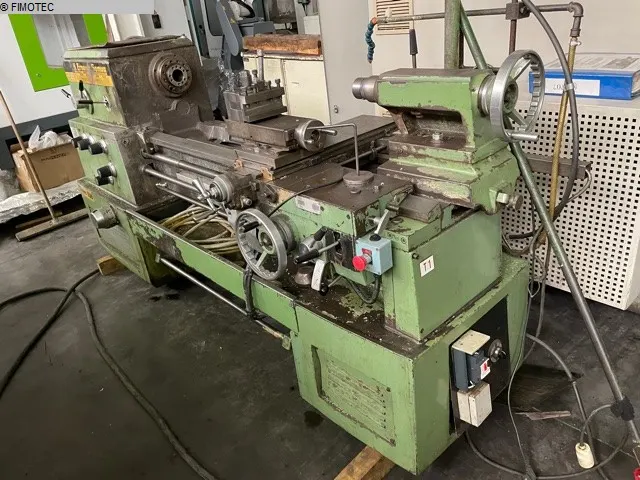
On a conventional lathe, feeds are applied by hand or through the leadscrew and feed shaft. A quick-change gearbox or change gears set the ratio between spindle rotation and carriage travel, which makes it possible to cut metric or inch threads; to cut a thread, the operator engages the leadscrew half nut.
The toolroom lathe, the most refined version of the conventional lathe, is built for one-off parts and small batches: versatility comes before productivity. A wide range of spindle speeds and feeds, adjustable stops and micrometric settings allow a skilled turner to machine complex parts. A three-jaw chuck, a four-jaw faceplate and a steady rest cover most set-ups.
Its strengths come from its simplicity: little preparation, great versatility and economical use for single parts and very small batches.
The CNC lathe: the program does the work
On a CNC lathe, each feed axis has its own motor and measuring system, and backlash-free ball screws drive the slides. Tool movements are defined in a program, written by hand by the programmer or generated by CAM software, then loaded into the machine. Once the machine is set up and the first part approved, it turns out parts under the occasional supervision of an operator.
CNC lathes have replaced older production lathes thanks to their ease of set-up, repeatability and accuracy. A turret holds the tools and indexes them as needed, and the bed is often slanted to help chip removal.
For threading, CNC controls provide canned cycles: a few program lines are enough to chain the passes automatically, whereas the turner repeats them by hand on a conventional machine.
One-off part, repair or series?
The quantity to be produced is often the first criterion.
- Single part, repair, breakdown work: the conventional lathe keeps the edge when an existing part has to be reworked or a simple part made quickly. On a CNC lathe, work preparation and the cost of a simple one-off part can be higher.
- Small and medium batches: the CNC lathe becomes worthwhile as soon as the same part comes back. Programming and tool presetting can be done while the machine is producing, which reduces downtime between batches.
- Series: in series production, numerically controlled machines have replaced manually operated lathes. Once the program is approved, each part follows the same cycle, with constant production times that are easy to plan.
Skills and programming
Both machines require real know-how, but not the same kind.
- On a conventional lathe, part quality depends directly on the turner: choice of speeds, depths of cut, reading the dials, threading.
- On a CNC lathe, the setter-operator also needs a high level of skill: writing or adapting a program, setting tools, approving the first part. The same operator often sets and runs several machines.
- Interfaces vary from one control maker to another, which can confuse an operator used to a different control. Programming is done in G-code according to DIN 66025, taking the manufacturer's instructions into account.
For a training workshop, the choice depends on what is being taught: the basic turning skills and manual control of the slides on a conventional lathe, programming and set-up on a CNC lathe. The same workshop may need both.
Turning centres: driven tools and C axis
On many CNC lathes, all or some of the turret stations can take driven tools, powered to drill or mill. The spindle can then be oriented to a precise angle and controlled as a full numerical axis: this is the C axis, rotation about the spindle's Z axis. Combined with the other axes, it allows complex toolpaths. Drilling and milling that used to require a second operation on a drill or milling machine can then be done on the same machine: this is known as complete machining.
Sliding-head lathes: small, long parts
For long, small-diameter parts, the sliding-head lathe, also called Swiss-type lathe, works differently: the bar is clamped in a collet and supported by a guide bush, and it is the material that moves back and forth along the Z axis in front of tools that stay fixed in Z. The distance between the cutting point and the guide bush remains constant, which limits deflection and vibration.
These machines, which originated in watchmaking, are also used to make medical and dental instruments. CNC models often include a sub-spindle that picks up the part after parting off to machine its other side, as well as driven tools. CNC bar turning makes small and medium batches profitable, with little downtime.
In short
- One-off parts, repairs, maintenance: a conventional lathe is often enough.
- Repetitive parts, small or large batches, complex shapes: a CNC lathe.
- Turned parts with drilling or milling: a turning center with driven tools and a C axis.
- Small, long parts in series: a sliding-head lathe.
Each machine page in our stock shows the specifications recorded on the machine, its control and, when available, the manufacturer's data, for example for this Ernault-Somua Cholet 550 conventional lathe. The price is given on request, and if the lathe you need is not in stock, we can search for it for you.