Grinding removes material with an abrasive wheel, each abrasive grain cutting a tiny chip. It produces surfaces with low roughness and high accuracy of shape and dimension: it is most often a finishing operation, after turning or milling, that removes little material. Choosing a used grinding machine starts with the type of machine, continues with reading the specifications and ends with examining a few assemblies specific to these machines.
The main types of grinding machines
Surface grinders
They grind flat surfaces. The workpiece sits on a reciprocating or rotary table under the wheel. Ferrous workpieces are held by a magnetic chuck, either a manually operated permanent-magnet chuck or an electromagnetic one; other materials are held by vacuum or mechanical means.
- Horizontal spindle: the periphery of the wheel does the work. This is the configuration for precision work on flat and angled surfaces, slots and profiles.
- Vertical spindle: the face of the wheel does the work. This configuration is often used for fast material removal.
External and internal cylindrical grinders
Both the workpiece and the wheel rotate; the wheel is fed towards the workpiece, and one traverses along the other. An external cylindrical grinder has a workhead, a wheel spindle and usually a tailstock: the workpiece is held between centres, in centre holes drilled at its ends, or by other clamping means. An internal grinder works on bores; it often has several swivelling wheel spindles.
Centreless grinders
The workpiece is held neither between centres nor in a collet: it rests on a work rest blade, between the grinding wheel and a regulating wheel. In through-feed grinding the workpiece passes right through the machine; in in-feed grinding it is loaded and then ground in place, which allows more complex shapes. The process is favoured when many parts must be processed in a short time.
Tool and profile grinders
A tool and cutter grinder sharpens milling cutters, drills and other cutting tools and handles toolroom grinding work. Profile grinders reproduce on the workpiece a shape given to the wheel: a dressing device creates this profile on the wheel, and on a CNC machine the dressing program defines it.
Specifications to compare
- Capacity: grinding area (length × width) and height under the wheel for a surface grinder; distance between centres and maximum diameter for a cylindrical grinder.
- Wheel: diameter and width of the wheel the machine accepts. The permitted speed depends on the wheel diameter and the wheel manufacturer's rating.
- Magnetic chuck: dimensions, permanent-magnet or electromagnetic type.
- Dressing: a dresser mounted on the table or on the wheelhead, with a diamond or a roll. Each dressing reduces the wheel diameter; recent grinders take this difference into account.
- In-process gauging: on the most automated machines, the workpiece is measured at regular intervals and the cycle adapts to the result.
- Control: a conventional grinder needs an operator in attendance; an NC or CNC machine runs programmed cycles. On a surface grinder, even a semi-automatic one, depth of cut and spark-out passes can be preset.
Condition points specific to grinders
Wheel spindle and wheel
Listen to the spindle across its speed range and watch how much it heats up. A wheel worn out of round is also out of balance: it makes the machine vibrate and spoils the surface finish. Dressing restores roundness and exposes fresh grains. Vibration that persists after dressing is worth investigating.
Slideways and hydraulics
On a surface grinder, the longitudinal table feed is usually hydraulic, and sometimes the cross feed too. Check for leaks, for smooth table motion, including at low speed, and for the condition of the slideways and their covers.
Coolant and swarf removal
Grinding generates a lot of heat: coolant keeps the workpiece from overheating and going out of tolerance. The machine must also remove metal and abrasive particles. Inspect the tank, the pump, the filtration or settling system and, if fitted, the extraction unit.
Magnetic chuck
Check the chuck surface for dents, scratches and corrosion. Make sure it holds a ferrous workpiece properly and, on an electromagnetic chuck, that the magnetising control works.
Dresser
Check the condition of the diamond or roll and that the device works, whether manual or automatic. Without reliable dressing, the wheel cannot keep its shape and cutting ability.
A grinding test
If possible, have a representative part ground, with a few spark-out passes (passes without resetting the depth of cut, until the sparks stop), then measure it.
Grinding machines at Fimotec
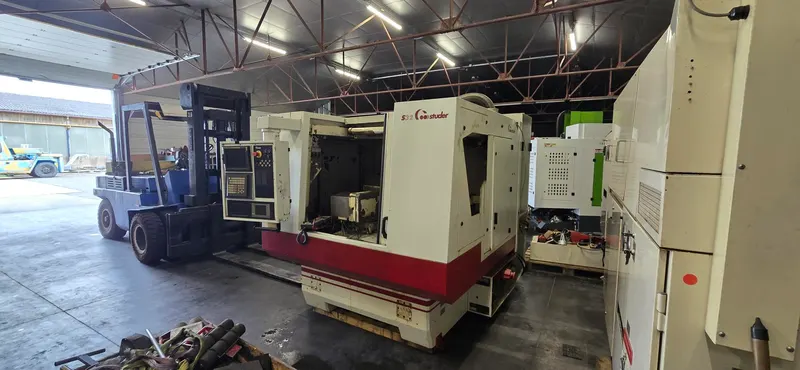
Our stock includes grinding machines with conventional, NC and CNC controls. Each machine page shows the specifications recorded on the machine, the control and, when available, the manufacturer's data with their origin. For example, the page for the Chevalier FSG 818 AD, with conventional controls, lists a grinding area of 450 × 200 mm, and the page for the Studer S32 a GE Fanuc Series 16i-T control. The price is given on request and every enquiry receives an answer within 48 working hours. If the grinder you need is not in stock, we can search for it for you.